Traumatic Brain Injuries From Accidents in Baton Rouge: What Doctors & Lawyers Both Need to Tell You
- Lindsey Scott

- Jun 2
- 13 min read
Quick Answer: What should I know medically and legally after a traumatic brain injury from a Baton Rouge accident?
Medically: seek evaluation immediately TBI symptoms can be delayed and invisible on initial scans. Legally: TBI cases are worth significantly more than typical injury claims, but they are also the hardest for insurance companies to dispute fairly — and the easiest for insurers to minimize. A brain injury attorney Baton Rouge at Lindsey Scott Law Firm knows how to document, prove, and fight for the full lifetime value of a TBI claim.
You walked away from the accident.
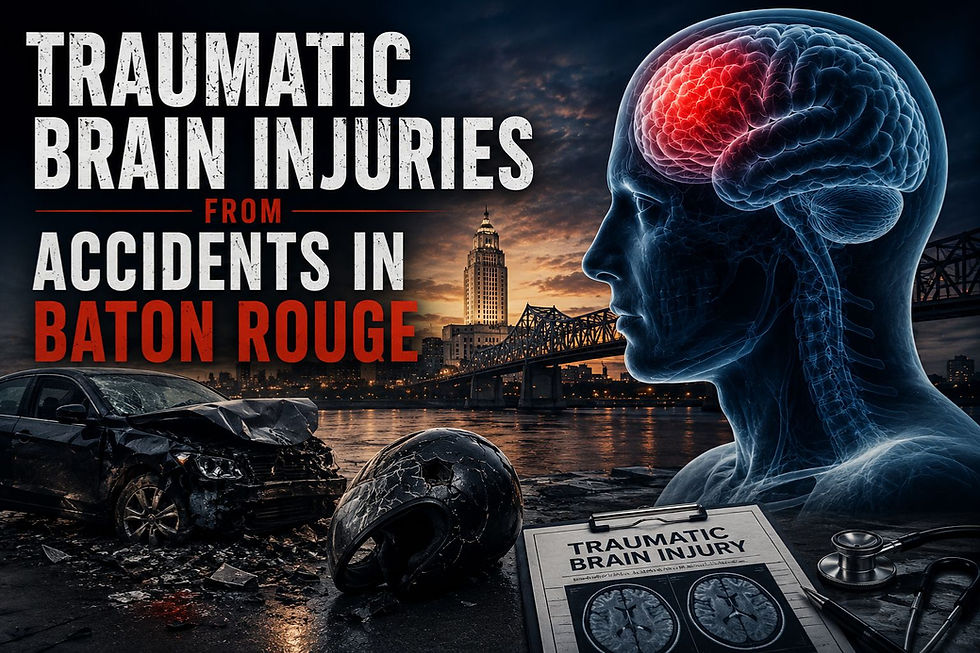
That is what you told yourself. That is what you told the paramedics. You were shaken up. Maybe a little sore. But you could walk. You could talk. The car accident was bad, but you were okay.
Three days later, you could not remember what you had for breakfast. You snapped at your family for no reason. Your head felt like it was wrapped in cotton. The light from the window gave you a splitting headache.
You were not okay. You had a traumatic brain injury — and no one told you.
This happens to Baton Rouge accident victims every single day. TBIs are the most underdiagnosed serious injury in car accidents, truck crashes, and falls. And they are one of the most undervalued injuries when it comes to insurance claims — because they are invisible, they are delayed, and they are complicated to prove.
This guide tells you both sides of the story — the medical reality of TBI and the legal reality of fighting for fair compensation. It is written by the brain injury attorneys at Lindsey Scott Law Firm, and it is the guide we wish every Baton Rouge TBI victim had before they talked to an insurance adjuster.
What Is a Traumatic Brain Injury — And Why Accident Victims Often Do Not Know They Have One
A traumatic brain injury happens when the brain is damaged by a sudden external force. In car accidents and truck crashes, this force comes from the violent movement of the head — the brain literally moves inside the skull, hitting the inside walls, twisting, and shearing.
You do not need to hit your head on anything. In high-speed crashes, whiplash alone can cause the brain to accelerate and decelerate so fast that internal damage happens even without any contact.
Here is the part that surprises most people: the most common TBI symptom immediately after an accident is feeling mostly fine.
The brain swells slowly. Bleeding can take hours to become significant. The symptoms that signal a serious brain injury confusion, memory problems, personality changes, light sensitivity, chronic headaches often do not show up until days or even weeks after the crash.
Insurance companies know that TBI symptoms are delayed. They use this against you. If you said you felt okay at the scene or accepted a quick settlement before the symptoms appeared they will argue you were not seriously hurt. Get a brain injury evaluation immediately after any significant accident. Do not wait for symptoms to force you.
The Three Levels of TBI — How Each One Changes Your Life and Your Legal Claim
Not all traumatic brain injuries are the same. The medical community categorizes them in three levels — and the legal value of your claim changes dramatically depending on which level applies to you.
Mild TBI (Concussion) Medical Impact: Brief loss of consciousness or none. Headaches, dizziness, memory problems, light sensitivity, mood changes. Can last weeks to months. Legal Impact: Often dismissed by insurers as 'just a concussion.' But untreated concussions cause long-term cognitive damage — this must be fully documented from day one. | Moderate TBI Medical Impact: Loss of consciousness minutes to hours. Significant cognitive impairment, behavioral changes, physical deficits. May require weeks of rehabilitation. Legal Impact: Insurance adjusters still fight these claims aggressively. Independent neuropsychological testing is critical to establish the true cognitive impact. | Severe TBI Medical Impact: Extended unconsciousness or coma. Permanent cognitive, physical, or behavioral impairment. May require lifelong care and supervision. Legal Impact: These cases can be worth millions. Future care costs, lost earning capacity, and caregiver needs must all be calculated with expert precision. |
Many 'mild' TBIs are not mild at all in terms of life impact. Post-Concussion Syndrome can cause months or years of cognitive problems, personality changes, and inability to work. The legal label 'mild' must never be allowed to minimize your actual damages.
TBI Symptoms After a Baton Rouge Accident — The Ones Victims Miss Most
Knowing what to watch for after any serious accident in Baton Rouge can save your health and your legal claim. These are the most commonly missed TBI symptoms after car crashes, truck accidents, and falls.
Physical Symptoms
| Cognitive & Emotional Symptoms
|
Medical Advice: If you experience any of these symptoms after a Baton Rouge accident — even days later seek a medical evaluation immediately. Ask specifically for a neurological assessment and mention the accident. Early diagnosis changes both your medical outcome and your legal case.
Why TBI Is the Hardest Injury to Prove And How Insurance Companies Exploit That
Broken bones show up on X-rays. Lacerations are visible. But traumatic brain injuries are often invisible — standard CT scans and MRIs can come back normal even when a person has a serious TBI.
Insurance companies know this. And they use it aggressively to deny and minimize TBI claims.
The Challenge | How Insurers Use It Against You | How Lindsey Scott Law Firm Fights Back |
Normal CT/MRI scan | 'No brain injury — scans are clean' | Obtains neuropsychological testing, functional MRI, DTI imaging that detects diffuse axonal injury invisible on standard scans |
Delayed symptom onset | 'You were fine after the accident' | Medical records establish the biological timeline of TBI symptom development — delayed onset is clinically expected |
Invisible symptoms | 'No objective evidence of injury' | Works with neuropsychologists and cognitive specialists to document memory, processing, and personality changes objectively |
Pre-existing conditions | 'These were pre-existing issues' | Obtains prior medical history showing the person was cognitively normal before the accident — the 'eggshell skull' doctrine protects you |
Quick return to activity | 'Couldn't have been that serious' | Documents the reality of 'masking' — TBI victims often push through early symptoms before the full impact becomes apparent |
Inconsistent presentation | 'Symptoms come and go — not real' | Educates with expert testimony that TBI symptoms fluctuate — good days and bad days are medically expected |
The most important thing you can do for a TBI claim is get properly diagnosed — not just an ER scan, but a full neuropsychological evaluation. The second most important thing is having a Baton Rouge TBI attorney who knows how to present that evidence in a way that makes it impossible to dismiss.
What a Traumatic Brain Injury Claim Is Worth in Baton Rouge, Louisiana
TBI claims are among the highest-value personal injury cases in Louisiana — because the impact of a brain injury touches every single aspect of your life, your work, and your future.
The total value of your claim must account for everything the injury costs you — not just today, but for the rest of your life. Lindsey Scott Law Firm works with medical economists, life care planners, and neuropsychological experts to calculate every dollar.
Economic Damages
| Non-Economic Damages
|
TBI damages are lifetime calculations not just current bills. A moderate TBI in a working adult can result in millions of dollars in total damages when future care and lost earning potential are properly accounted for. Insurance first offers almost never come close to this. Lindsey Scott Law Firm best accident injury lawyers Baton Rouge calculates the real number.
The Most Common Causes of TBI in Baton Rouge Who Is Liable
Traumatic brain injuries from accidents in Baton Rouge come from many different types of incidents. The cause of the accident determines who can be held liable — and how much total compensation may be available.
Cause of TBI | Who May Be Liable |
Car or Truck Accident | At-fault driver, trucking company (if commercial vehicle), vehicle manufacturer (if defective safety systems) |
18-Wheeler Crash | Truck driver, trucking company, cargo loader, maintenance contractor — multiple liable parties often apply |
Slip and Fall | Property owner or business who failed to maintain safe conditions |
Workplace Accident | Employer (workers' comp) + third-party contractors or equipment manufacturers |
Sports or Recreational Injury | Facility owner, equipment manufacturer, event organizer if safety standards were violated |
Assault or Violence | Individual attacker + property owner if security was negligent (premises liability) |
Defective Product | Manufacturer of the product that caused the head injury — car parts, helmets, safety equipment |
Medical Negligence | Healthcare provider if improper treatment or mismanagement caused or worsened a brain injury |
What to Do After a Potential TBI From a Baton Rouge Accident Your Step-by-Step Guide
Every step you take in the hours and days after a potential TBI affects both your recovery and your legal claim. Here is what matters most.
1 | Go to the ER or Urgent Care — Even If You Feel Okay Say these words: 'I was in an accident and I may have a head injury.' An ER visit creates a medical record from day one. TBI symptoms can be delayed — do not wait for them to get worse before seeking care. |
2 | Request a Neurological Evaluation A standard ER scan often misses TBI. Ask specifically for a neurologist referral. If you develop any cognitive, emotional, or physical symptoms in the days following the accident — memory issues, headaches, mood changes — get to a neurologist or neuropsychologist immediately. |
3 | Keep a Daily Symptom Journal Write down every symptom, every day — headaches, memory problems, difficulty concentrating, mood changes, sleep issues. This journal becomes important medical and legal evidence. Be specific: when symptoms appeared, how long they lasted, and how they affected your daily life. |
4 | Tell Every Doctor About the Accident At every medical appointment, tell the provider you were in an accident. Connect every symptom to the accident clearly in your medical record. Gaps or unclear connections in medical records are used by insurers to argue symptoms are not accident-related. |
5 | Do Not Downplay Symptoms to Anyone Not to your doctor. Not to the insurance adjuster. Not to your employer. TBI victims often minimize their symptoms — especially cognitive ones — because they feel embarrassed or do not want to seem weak. This habit seriously hurts your claim. |
6 | Do Not Give a Recorded Statement Insurance adjusters will ask how you are feeling. 'I'm okay' or 'I'm doing better' can be used to deny TBI claims months later. Say nothing to any insurer before speaking with a TBI attorney in Baton Rouge. |
7 | Contact Lindsey Scott Law Firm TBI cases require immediate legal action — preserving evidence, retaining medical experts, and countering the insurer's strategy before it locks in. Your free consultation costs nothing. Your case could be worth your financial future. |
Why TBI Victims in Baton Rouge Choose Lindsey Scott Law Firm
Traumatic brain injury cases are the most complex personal injury claims there are. They require medical experts, neuropsychological testing, life care planners, economic analysts, and attorneys who understand the science well enough to explain it to a jury in plain English.
At Lindsey Scott Law Firm, we handle TBI cases as a core practice. We have built relationships with the medical specialists who do this work. We know how to document cognitive and emotional damage in ways that are hard to dismiss. And we know how to take these cases to court when insurance companies refuse to be fair.
No win, no fee: You pay nothing unless we win your case.
Free consultation: Honest answers about your TBI claim at zero cost.
Medical and legal expertise: We work with neurologists, neuropsychologists, and life care planners.
Full damage calculation: Lifetime medical costs, future earning loss, pain and suffering — every dollar.
Invisible injury specialists: We know how to prove what does not show on a scan.
Louisiana law knowledge: We know Baton Rouge courts and Louisiana TBI case law inside out.
Trial ready: Every case prepared as if it goes to a jury — because that is what forces fair settlements.
A traumatic brain injury changes everything. It deserves a brain injury attorney in Baton Rouge who fights like it does.
Call Lindsey Scott Law Firm today for your FREE consultation. No fee. No risk. No obligation. Just the honest, expert legal help your TBI case demands.
Frequently Asked Questions — Traumatic Brain Injury Claims in Baton Rouge
Q1: How do I know if I have a traumatic brain injury after a Baton Rouge accident?
See a doctor immediately after any accident involving head impact or violent motion — TBI symptoms are often delayed and may not appear for days after the crash.
The most commonly missed TBI signs include persistent headaches, dizziness, memory problems, difficulty concentrating, irritability, sensitivity to light and noise, and sleep disturbances. You do not need to lose consciousness to have a TBI — many serious brain injuries happen without any blackout. Standard ER scans can miss TBI entirely. If you were in a significant car accident, truck crash, or fall in Baton Rouge, tell your doctor specifically about the accident and request a neurological evaluation. Early diagnosis is critical for both your medical recovery and the strength of your legal claim. Lindsey Scott Law Firm works with neurological experts who specialize in diagnosing accident-related TBI.
Q2: Can I still have a TBI if my CT scan came back normal?
Yes — a normal CT scan does not rule out a traumatic brain injury. Many serious TBIs are invisible on standard imaging.
Standard CT scans and even many MRIs can fail to detect diffuse axonal injury (DAI), the most common type of TBI in car accidents. DAI occurs when the brain's nerve fibers are stretched or torn by rapid acceleration-deceleration forces — it is a microscopic injury that does not appear on conventional imaging. Advanced tests like functional MRI (fMRI) and diffusion tensor imaging (DTI) can detect these injuries. Insurance companies frequently use 'normal CT scan' as grounds to deny TBI claims. Lindsey Scott Law Firm retains neuroimaging and neuropsychological experts specifically to document the injuries that standard scans miss — because a clean CT scan does not mean a clean bill of health.
Q3: How much is a traumatic brain injury lawsuit worth in Louisiana?
TBI lawsuits in Louisiana can range from tens of thousands for mild concussions to several million dollars for severe or permanent brain injuries — depending on the impact on your life and career.
The value of a TBI claim depends on injury severity, future medical needs, impact on earning capacity, age, and the quality of medical documentation. A mild TBI with full recovery may result in a claim worth $50,000–$200,000. A moderate to severe TBI with lasting cognitive or physical effects — especially in a young working adult — can exceed $1 million or more when future care, lost earnings, and pain and suffering are fully calculated. Insurance companies almost always offer a fraction of the real value. Lindsey Scott Law Firm works with life care planners and economic analysts to build a complete lifetime damages calculation for every TBI client in Baton Rouge.
Q4: How long do I have to file a TBI lawsuit in Louisiana?
In Louisiana, you have one year from the date of the accident to file a personal injury lawsuit for a traumatic brain injury — one of the shortest deadlines in the country.
Louisiana's one-year prescriptive period applies to TBI cases just as it does to other personal injury claims. It is strictly enforced — missing this deadline permanently eliminates your right to compensation, no matter how severe your injury. This time pressure is especially challenging for TBI victims whose symptoms are delayed or who may be cognitively impaired in the early weeks after injury. Contacting a brain injury attorney in Baton Rouge as soon as possible after your accident ensures the deadline is protected and that evidence — medical records, imaging, witness accounts, accident documentation — is preserved before it is lost.
Q5: What if the insurance company says my TBI symptoms are from a pre-existing condition?
Louisiana law protects you from this argument — the 'eggshell skull' doctrine requires defendants to take you as they find you, including any pre-existing vulnerabilities.
The eggshell skull rule (also called eggshell plaintiff doctrine) is a long-standing legal principle that holds a negligent party fully responsible for the harm they caused, even if the victim was more susceptible to injury than an average person. If you had prior headaches, depression, or any prior head injury history, the at-fault driver is still responsible for the TBI they caused — they cannot use your prior condition to escape liability. What they can argue is that some portion of your symptoms pre-dated the accident. Lindsey Scott Law Firm obtains pre-accident medical records and expert analysis to clearly separate what existed before the crash from what the crash caused.
Q6: What kind of expert witnesses are used in a TBI case in Baton Rouge?
TBI cases in Baton Rouge typically require neurologists, neuropsychologists, life care planners, and economic experts to properly document and value the injury.
A neurologist establishes the medical diagnosis and documents the nature and extent of the brain injury. A neuropsychologist administers cognitive testing to measure memory, processing speed, attention, and personality changes — creating objective documentation of invisible symptoms. A life care planner calculates the full cost of future medical needs — ongoing therapy, medications, care assistance, and potential long-term facility care. An economic expert calculates lost earning capacity — the difference between what you could have earned in your career and what you can earn now. Lindsey Scott Law Firm has established relationships with all of these experts and brings them into every serious TBI case we handle.
Q7: Can I file a TBI claim if symptoms appeared days after the accident?
Yes — delayed TBI symptoms are medically expected and do not reduce your right to a full legal claim.
It is well established in neurology that TBI symptoms often do not appear for 24 to 72 hours — or even longer — after the initial injury. Brain swelling, microscopic bleeding, and neurochemical changes develop over time. Insurance companies try to use the delay against you — arguing that if you were fine right after the accident, the symptoms must be from something else. This argument is medically unsound and legally incorrect. Louisiana courts have consistently allowed TBI claims where symptoms were delayed. The key is connecting your symptoms to the accident through medical documentation and expert testimony — which is exactly what Lindsey Scott Law Firm builds for every TBI client.
Comments